


Africolor with Groove Lélé, Ernst Reijseger, and Mola Sylla

December 21st, 2010
Facebook Twitter Linkedin

The 22nd edition of the Africolor festival is approaching the end of its season, with its final musical performances scheduled for Christmas Eve. Since 1989, when the first concert opened at the Théâtre Gérard Philipe in the town of Saint-Denis, Africolor has been bringing outstanding musicians to Seine-Saint-Denis (a French administrative département in the Ile-de-France region) to perform African and African-inspired music.

I had the pleasure of attending a concert at the MC93 theater in the nearby town of Bobigny on Sunday, December 5. The concert was a double treat because for the price (16€) of a single entry ticket, two groups from La Réunion would be performing: Groove Lélé with Ernst Reijseger and Mola Sylla; and the Danyèl Waro ensemble. In today’s blog I will present the first group, with my comments about the second reserved for another day.

Zembrocal is a popular dish of La Réunion that consists of turmeric, rice or corn, and red or white beans. The diverse people of this island sometimes compare themselves to this dish, because each element keeps its flavor and yet contributes to the overall taste. The group Groove Lélé that performed with Ernst Reijseger and Mola Sylla on Sunday afternoon exemplifies this idea—their music was a mixed bag of melodies masterfully interweaving European music, jazz, African rhythms, song, and dance. At one point I was wondering if I was listening to jazz, and at another I was wondering if I was listening to African music. I finally gave up trying to attach a label to it and decided to just listen and enjoy! If one were to ask the musicians what they were performing, they might say that it is maloya, a genre of music that is associated with Creole culture in La Réunion.
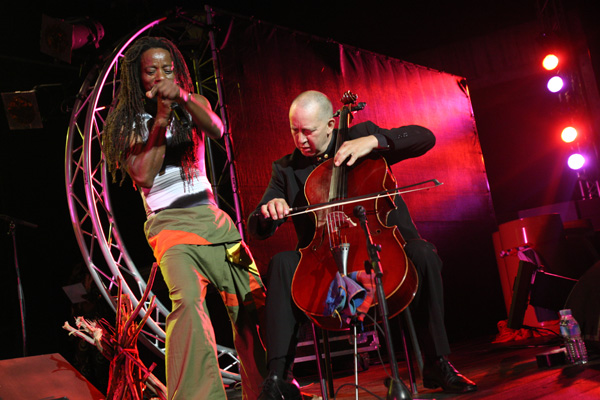
Willy Philéas of Groove Lélé and Ernst Reijseger
Photograph by Jean-Claude François
Courtesy of La Strada Mundi

The performances by Groove Lélé, a group of about twelve singers, dancers, and percussionists, were dazzling. The group was founded in 1977 by Granmoun Philéas as a family affair. His goal: to sing and perform maloya, one of the two principal genres of music from La Réunion. With his passing in 2004, two brothers Willy and Urbain Philéas took over leadership of the group. In November of this year, it was awarded the Trophée des Arts Afro Caribéens for the best album of 2010.

Joining Groove Lélé on stage were two outstanding musicians, Ernst Reijseger and Mola Sylla.

Ernst Reijseger is a Dutch cellist who specializes in jazz and contemporary classical music. He has stated that he does not play a standard repertoire when onstage. Rather, he improvises all the way through the performance!

Mola Sylla is a percussionist and singer from Dakar, Senegal. Of his music, Sylla has said, “Previously I only played African music, and now I do not know even what I play. Some people hear elements of classical music, others call it World Music – whatever that is supposed to be – or even pop music. I believe it does not matter. If I play, I feel free.” (Volkskrant Magazine, June 1, 2001)

The three elements of the show, Groove Lélé, Ernst Reijseger, and Mola Sylla, combined their talents to serve up a fine dish of zembrocal guaranteed to please the most discriminating palates!

Mola Sylla
Photograph by Jean-Claude François
Courtesy of La Strada Mundi

Groove Lélé Percussionists
(c) Discover Paris!

Groove Lélé Singers, Dancers, and Percussionists
(c) Discover Paris!

Groove Lélé Singer with Percussionists
(c) Discover Paris!
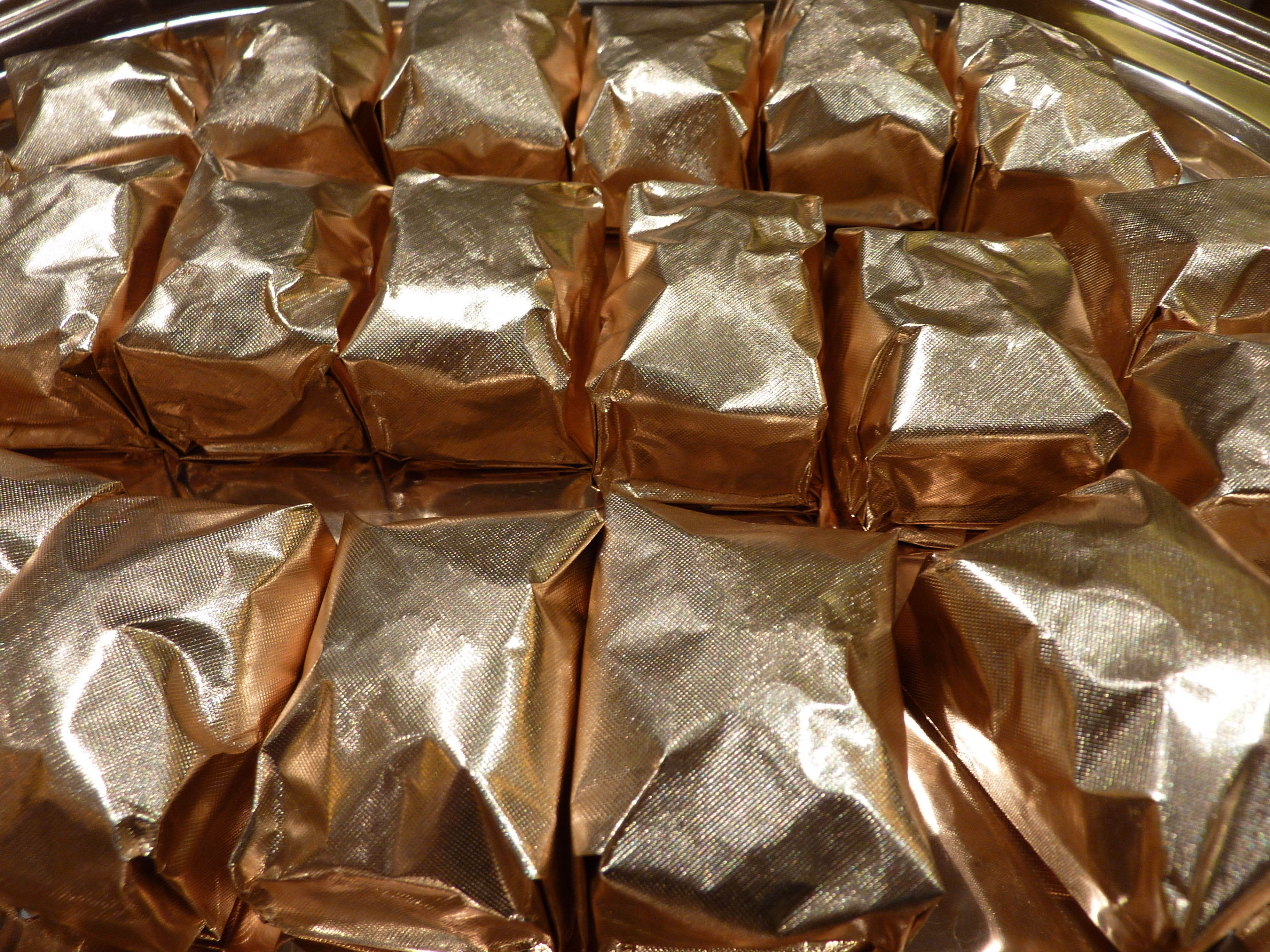

Marrons Glacés – A Sweet Confection for the Holiday Season

December 18th, 2010
Facebook Twitter Linkedin

Marrons Glacés
(c) Discover Paris!

Marrons glacés (candied chestnuts) are part of the Christmas holiday tradition in France. In December, their individual, gold-foil wrappers in the storefront windows of chocolate shops and other confectionary outlets attract the eye and entice those of us with a fondness for sweets. The candy-making process is so tedious and the final product so fragile that only a few companies make marrons glacés in France.

We sampled a number of marrons glacés that we purchased at different chocolate shops in Paris, took them back to our kitchen, and then tasted them, comparing the qualities of each against the others. Read our report entitled “Marrons Glacés – A Sweet Confection for the Holiday Season” in this month’s issue of Paris Insights.

Our monthly newsletter, Paris Insights, is available by paid subscription. To subscribe, click here.

Wandering Educators Reviews Paris Insights – An Anthology

December 16th, 2010
Facebook Twitter Linkedin

Wandering Educators, “a global community of informed, engaged educators who share their travel experiences, explore their fellow wandering educators’ travel experiences, and dialogue about international education and travel,” has just published a review of my book Paris Insights – An Anthology. The editor of the Web site, Jessie Voigts, also asked me some pertinent questions about my reasons for writing the book.

Thank you, Wandering Educators, for the great review!

Paris Insights – An Anthology will make a fine Christmas gift for the traveler who is planning a visit to Paris, or the armchair traveler who simply wants to learn what makes the city such a fascinating place!

A Mococha Christmas
By Monique Y. Wells

December 15th, 2010
Facebook Twitter Linkedin

We recently stopped by Marie-Hélène Gantois’ chocolate shop—Mococha—on rue Mouffetard to see what chocolate confections she is offering for the Christmas season.

Marie told us that this Christmas she has several new products for chocolate lovers.

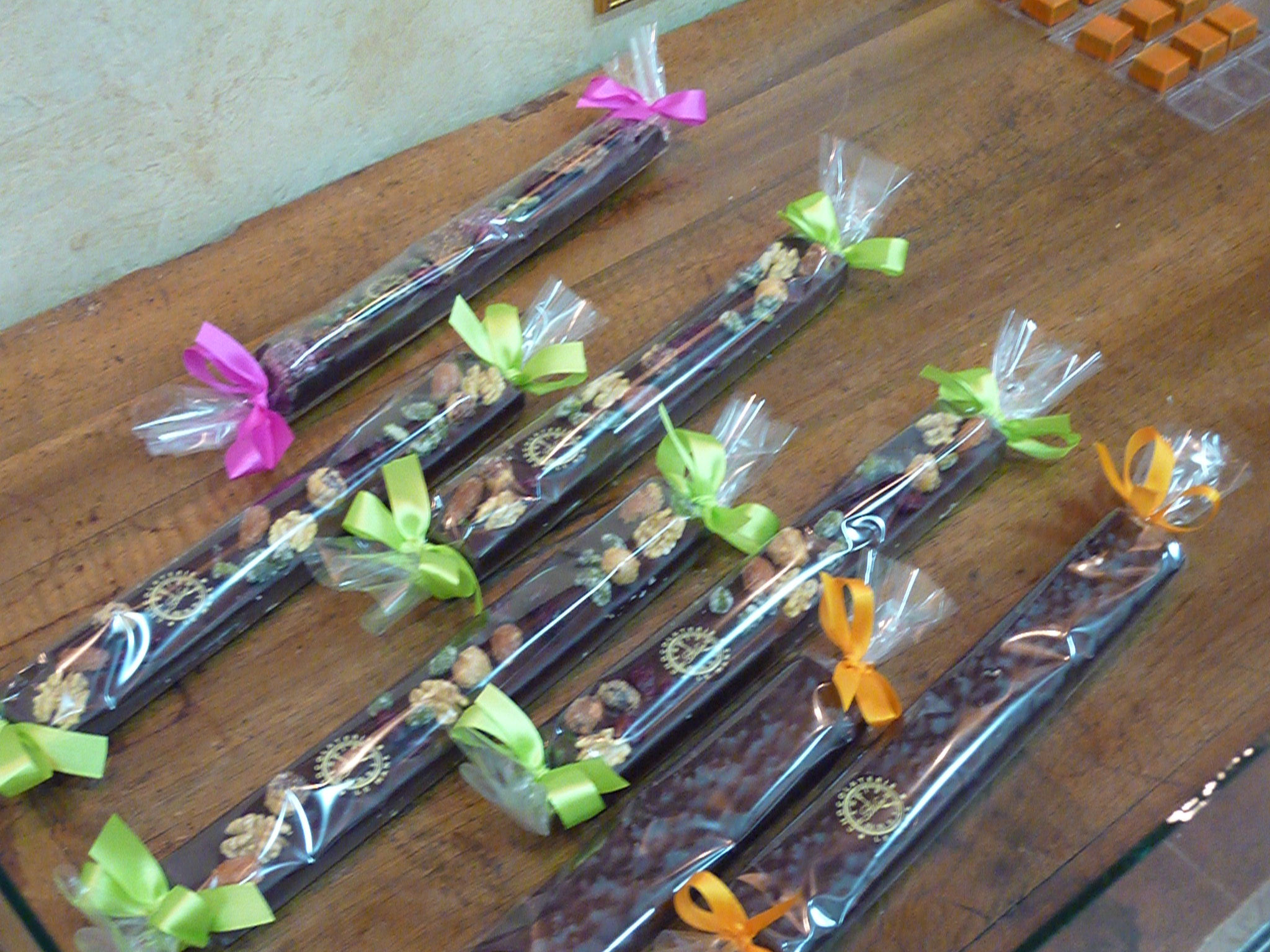
From chocolate maker Jacques Bellanger (named Meilleur Ouvrier de France in 1982—best pastry chef and confectioner), there are three types of crunchy bars:

Buggatise – crackly, crunchy praline layered with tender caramel accentuated by fleur de sel (sea salt), coated in dark chocolate

Sybille – the same praline, accompanied by almond paste elaborated with Sicilian pistachios, coated with dark chocolate and decorated with pistachios, almonds, cranberries, walnuts, and hazelnuts

Charlotte – praline with raspberry paste coated with dark chocolate and decorated with pistachios, dried figs, cranberries, and cubes of fruit paste.

Les Barres from Jacques Bellinger
(c) Discover Paris!
The bars are 25 cm (roughly 10 inches) long and are beautifully presented in a transparent wrap bound by ribbons on each end.

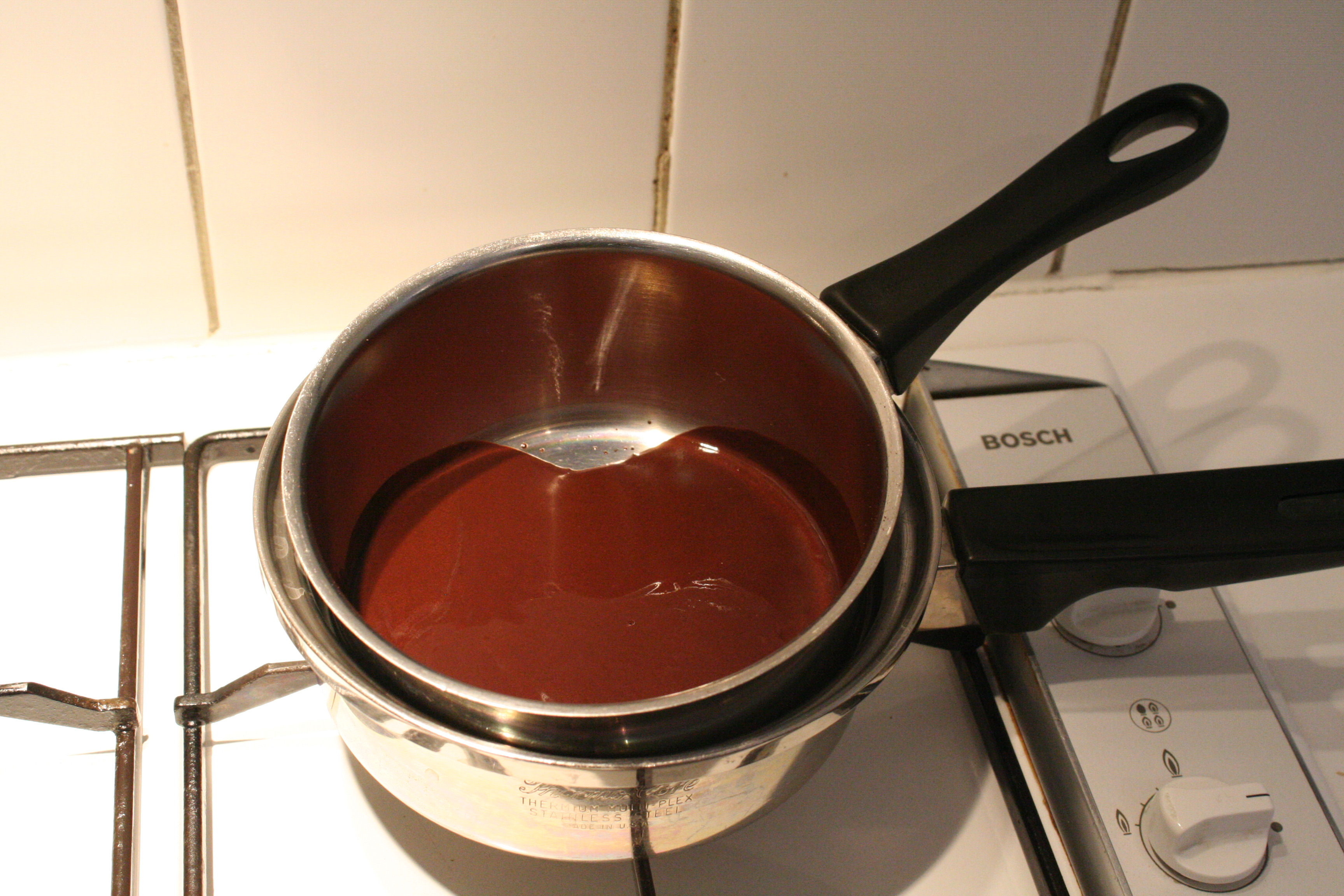
Marie has also assembled three chocolate delights in a package that she calls the Mococha “Coffret Craquant.” It is comprised of chocolate-covered, grilled almonds and chocolate-covered, grilled hazelnuts from Maison Weiss, and chocolate dragées wrapped in gold paper from Maison Médicis. There are also boxes of florentines and mendiants by Maison Weiss, chocolate-covered lemon peel and ginger by Weiss, chocolate-covered orange peels by Maison Corsiglia, and marrons glacés by Maison Corsiglia.

As connoisseurs of hot chocolate, we recommend that you stop by Mococha to sample Marie’s delectable brew! Made from Venezuelan dark chocolate (72%), whole milk, crème fleurette, and sugar, it is thick, rich, and slightly fruity in flavor. A cup of this beverage and a macaron by Jacques Bellanger warm both body and spirit!

Place Setting for Hot Chocolate and a Macaron

Mococha
89, rue Mouffetard
75005 Paris
Tel : 01.47.07.13.66
Metro: Censier Daubenton
Hours : Tuesday through Sunday 11 a.m. to 8 p.m.

Monique Y. Wells is cofounder of Discover Paris!—Personalized Itineraries for Independent Travelers and a freelance writer and editor. She is the author of two books, numerous articles about Paris, the Entrée to Black Paris™ blog, and the Les Amis de Beauford Delaney blog.

* * * * * * *

We participate in Wanderfood Wednesdays. Head over there to explore food from around the world!

A Mococha Christmas
By Monique Y. Wells

Paris Vegan Day

December 10th, 2010
Facebook Twitter Linkedin

Veganism is more than a diet—it is a lifestyle. This is the primary lesson that we learned when we attended Paris Vegan Day on November 28 at La Bellevilloise, a cultural center located in the 20th arrondissement of the French capital.

Our day began at La Halle aux Oliviers, a grand banquet room located in the back of the cultural center. There, we feasted on an all-you-can-eat vegan brunch, a meal that we recently reported on in our Paris Insights free restaurant review.

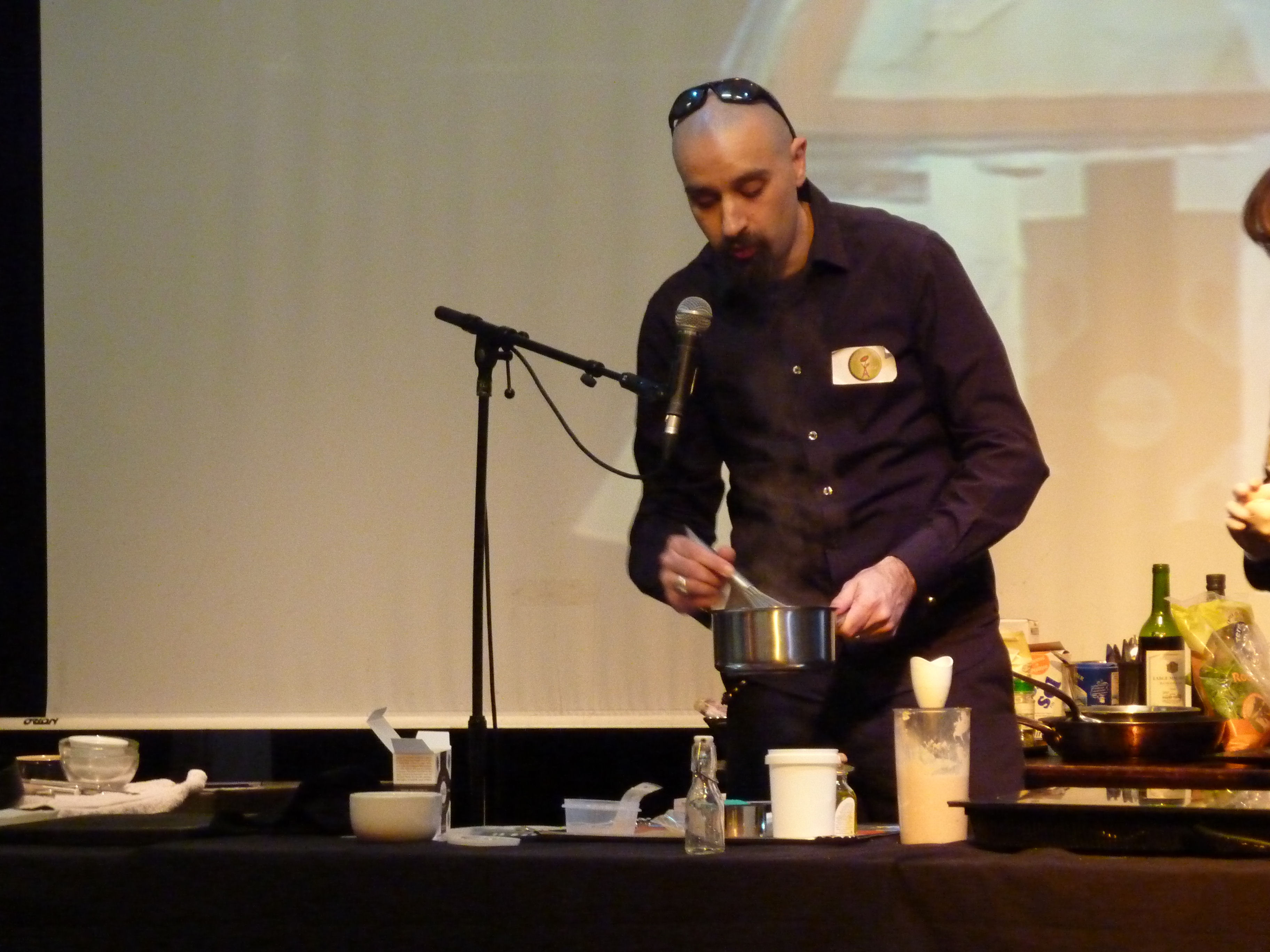
Cooking Demonstration
(c) Discover Paris!
Following the brunch, we entered the main area of the cultural center to see what Paris Vegan Day was all about. La Bellevilloise has three floors, each of which was devoted to vegan-centered activities. We entered the ground floor where a cooking demonstration was being given by Sébastien Kardinal. Sébastien was showing the large audience how to make Tofoie gras, a vegan alternative to foie gras. His recipe (in French) can be found on the VG-Zone Web site.

Food'Joie
(c) Discover Paris!
At the opposite side of the room, Elodie Beaucent was creating amusing faces from vegetables and fruit. She gives workshops to adults on how to make a balanced vegetarian lunch from organic food products; and to children on how eat healthfully and to create funny faces from food. She has a Web site (in French) at Food’Joie.

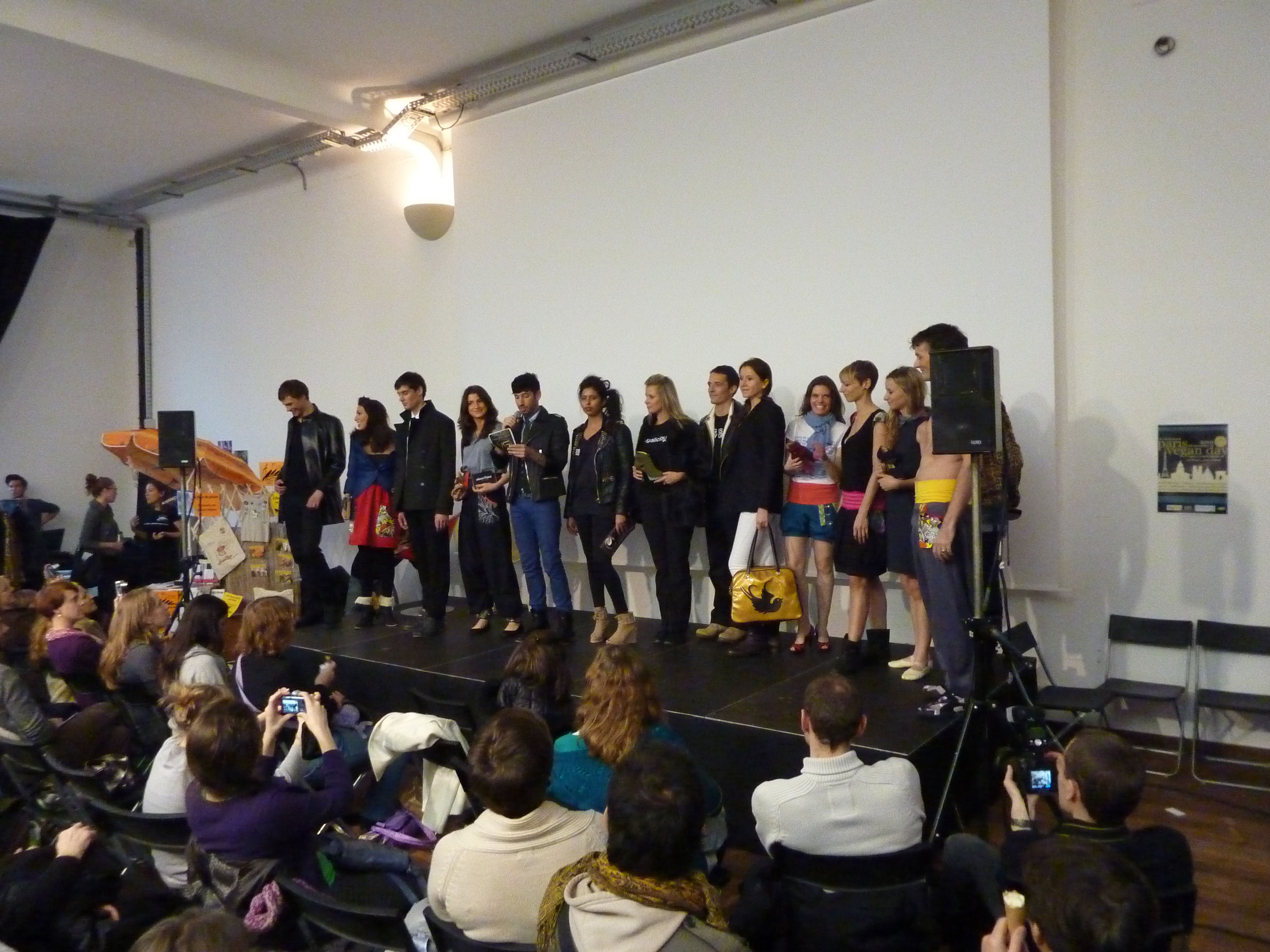
Vegan Fashions
(c) Discover Paris!
Going upstairs, we arrived just in time to see a fashion show of vegan clothing presented by Joshua Katcher of The Discerning Brute (Web site in English). Male and female models paraded out one by one demonstrating attractive clothing that incorporates no leather or wool. Instead, the leather-like jackets that the men and women were modeling were made from rubber! I had never heard of vegan clothing before, but the idea that there could be a market for these products made me realize that veganism was a way of life, much more than just a diet.

Vegan Speed Dating
(c) Discover Paris!
Walking over to the Freshman Consulting stand, a company that had set up a speed-dating service for vegans, the concept of veganism as a lifestyle became even more apparent. How could vegan and non-vegan partners ever hope to live together harmoniously? I wondered. Vegans eschew anything that exploits the use of animals in the service of man: leather and wool products; meat, fish, and poultry; animal testing for drug and cosmetic research and development; the consumption of milk, honey, and eggs… They consider that the exploitation of animals in any form by humans is morally wrong. A couple that does not adhere to this fundamental concept would, in my mind, be in constant conflict. For a man or a woman, then, to find a partner that subscribes to this principle, he or she must move in a circle of vegans, hence the usefulness of a vegan dating service at this event.

We moved about to other stands on this floor.

Dominique and Alice
(c) Discover Paris!
Dominique and Alice were selling justuman eco conscious t-shirts.

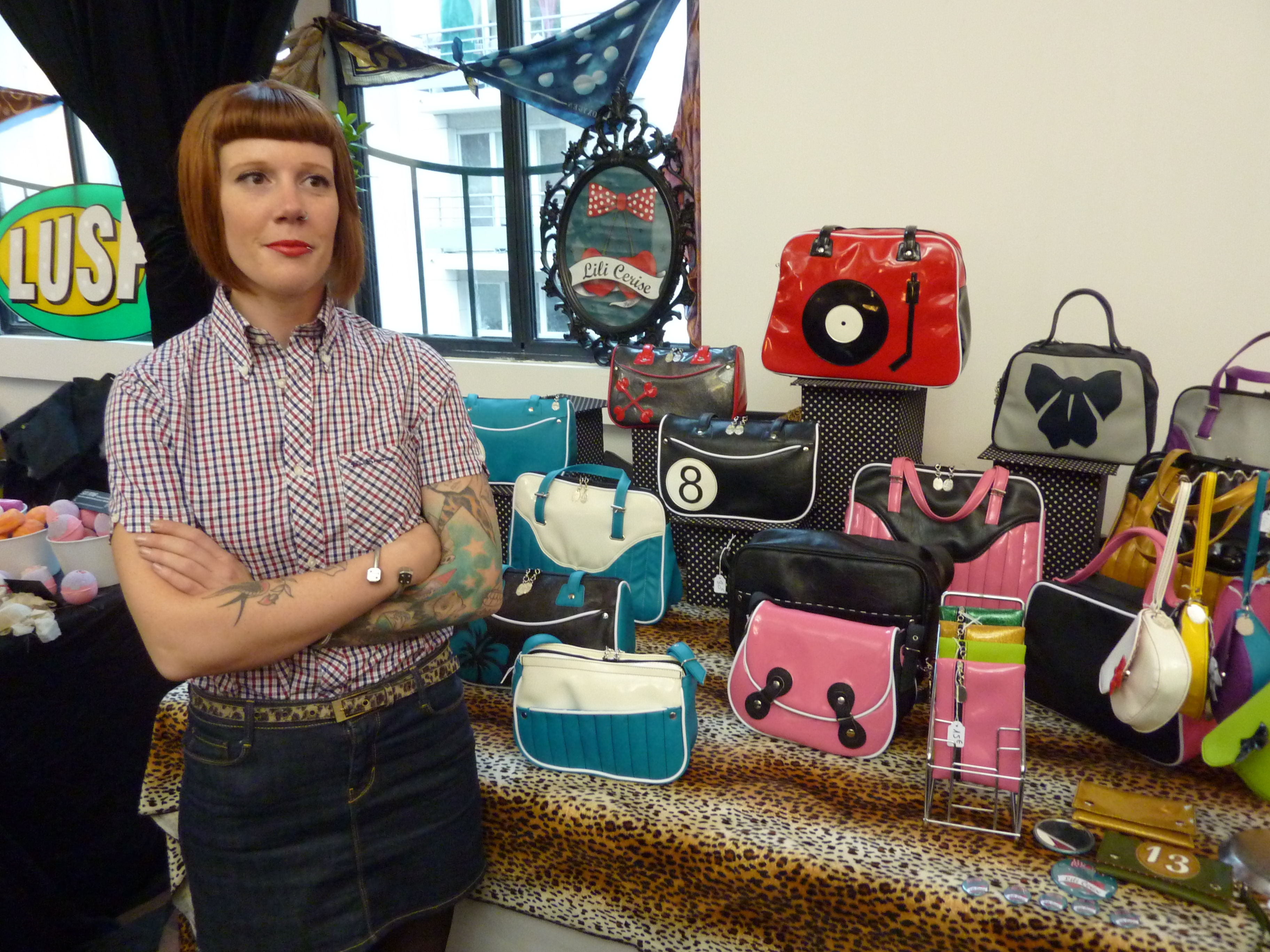
Lili Cerise
(c) Discover Paris!
Lili Cerise was selling cute handbags.

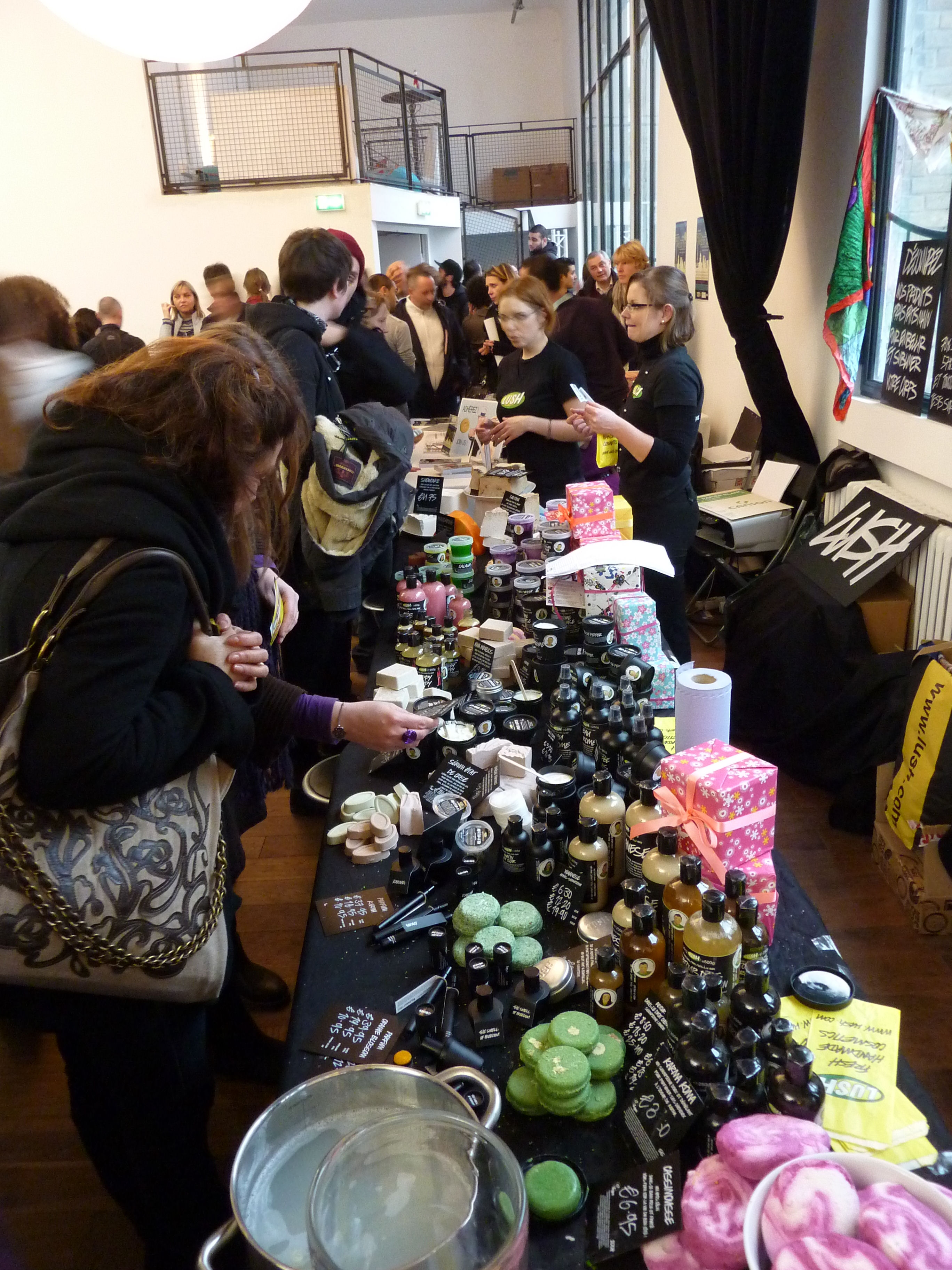
Lush Cosmetics
(c) Discover Paris!
Lush was selling cosmetics.

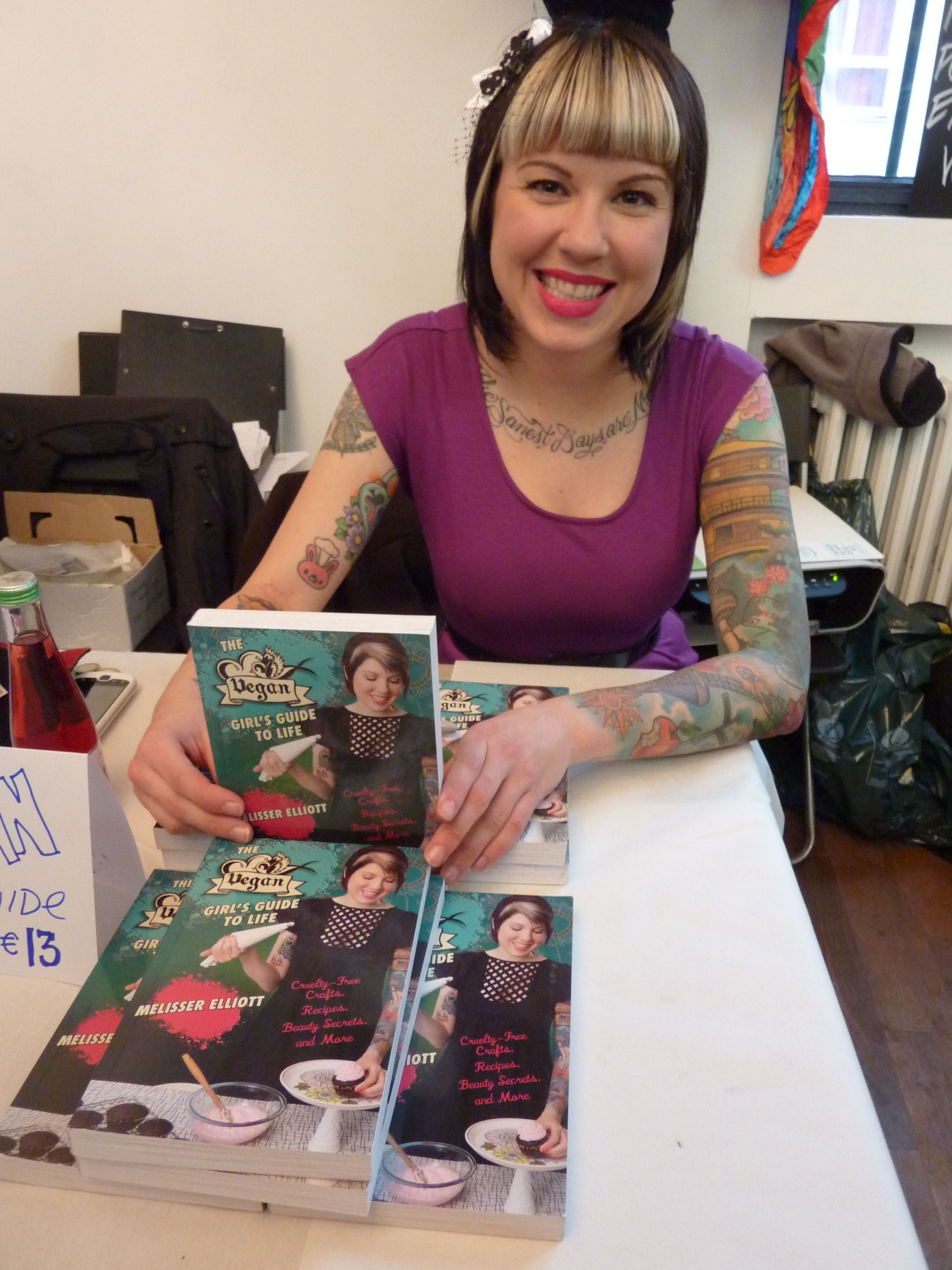
The Vegan Girl's Guide to Life
(c) Discover Paris!
Messler Elliot was selling her book The Vegan Girl’s Guide to Life.

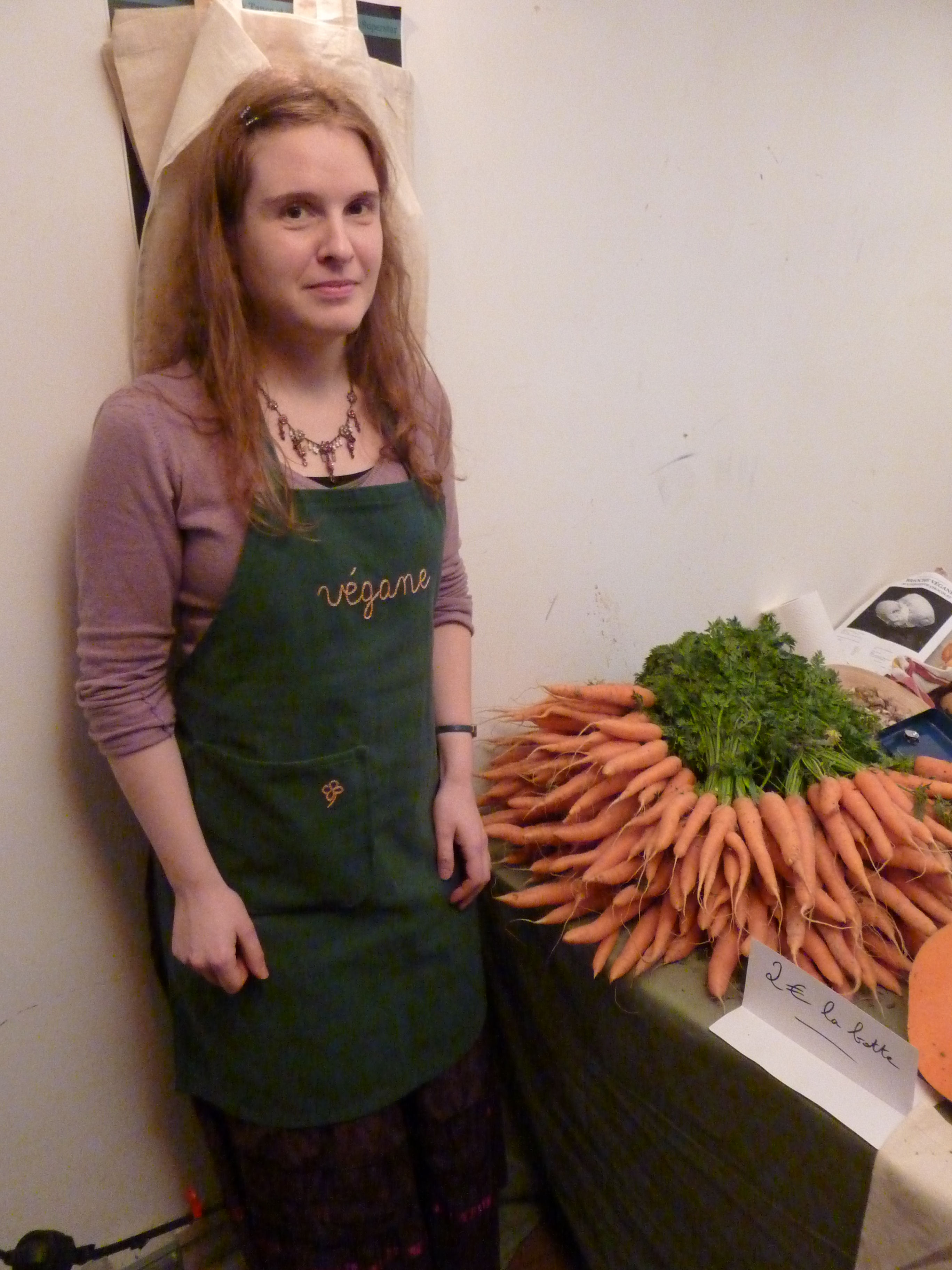
Jasmine
(c) Discover Paris!
And in the hallway, Jasmine was distributing a brochure entitled “Nutrition végétale” (Plant-Based Nutrition and Health).

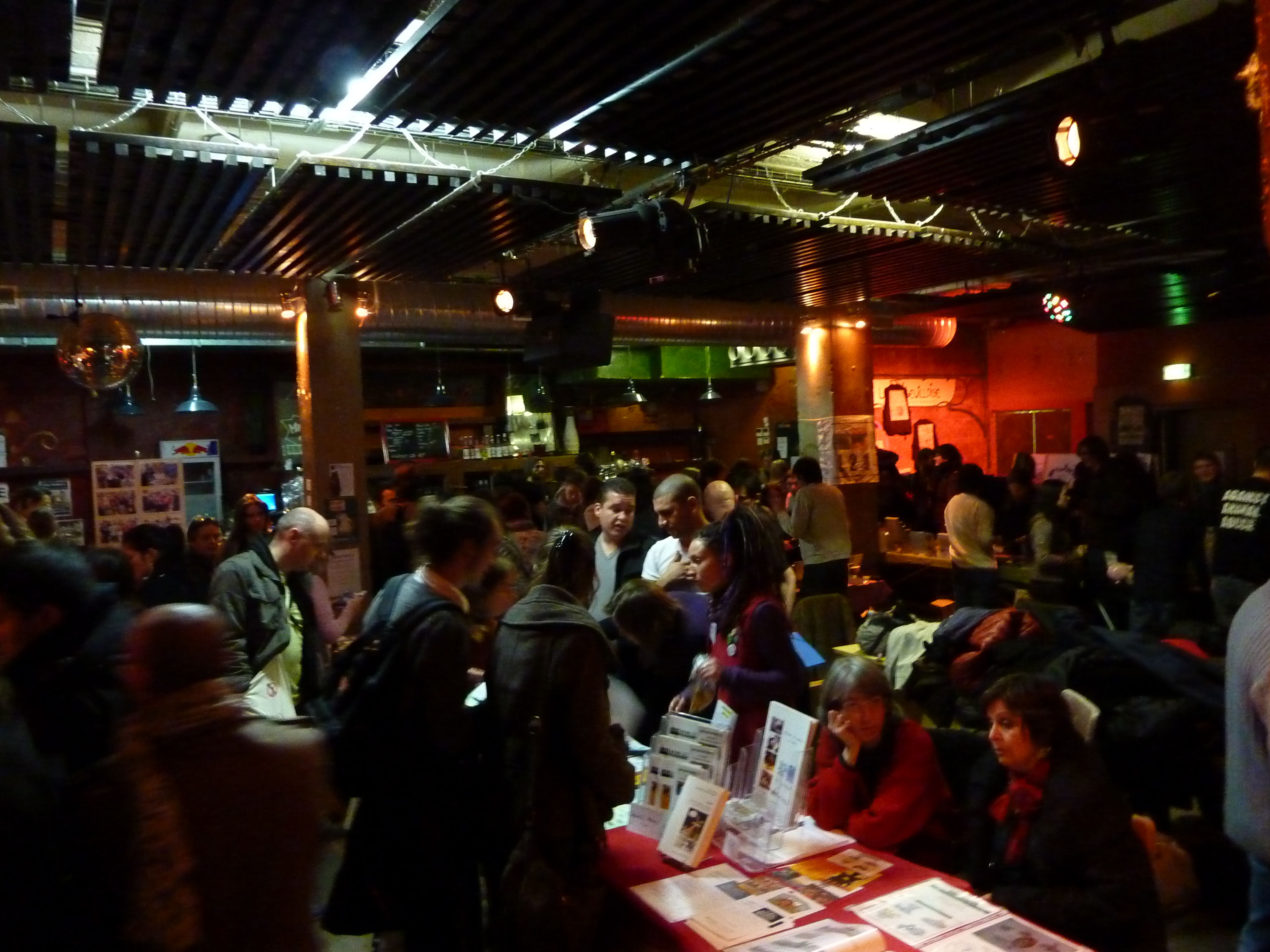
Downstairs Exhibitors
(c) Discover Paris!

Finally, we descended the stairway to enter the basement. This level is normally used as a nightclub, and we entered a vast, poorly-lit room with red lighting predominating. We found the effect to be rather sinister, so we did not remain long. This floor was given over to advocacy groups, including animal rights and anti-vivisection societies. A link to a Web site (in French) of one of these groups gives an idea of what they advocate, as well as their militancy.

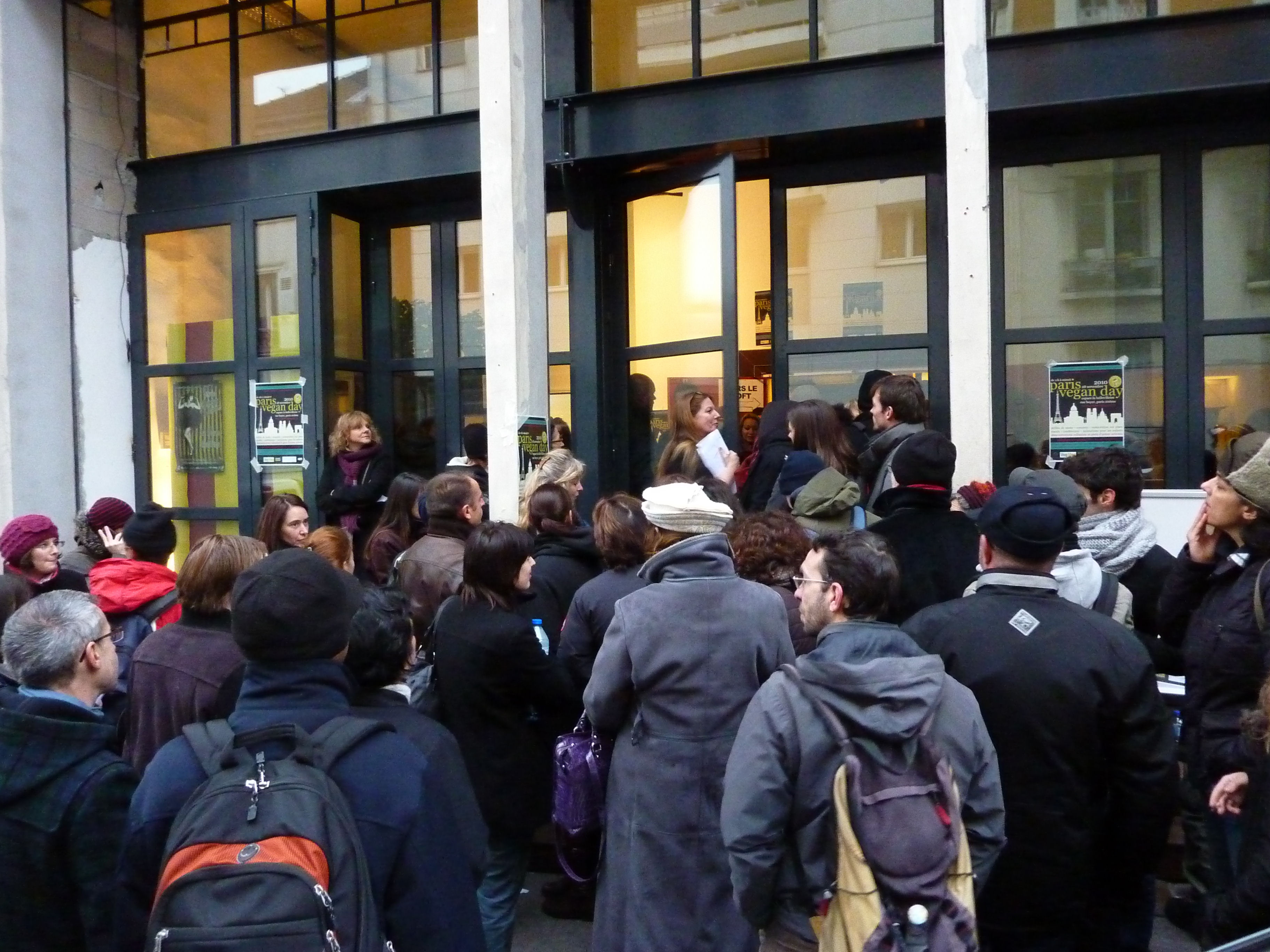
People Waiting to Get In
(c) Discover Paris!
As we left the building, we learned that attendance had exceeded all expectations. In fact, people were waiting on the sidewalk in the cold, because security regulations did not permit everybody to enter at once. Judging from the lively activities that went on within the cultural center, the enthusiasm of the attendees, and the number of persons waiting to get in, it was a successful event. Alexandre Pivan, one of the organizers, told us that he anticipates that in five years the city of Paris will be the leading center for veganism in the world!

Paris Vegan Day was organized by Deborah Brown Pivain and her son and daughter Alexandre and Caroline Pivain. The family owns and operates the Gentle Gourmet Bread and Breakfast in Paris. We dined at their establishment in April of this year and reviewed their cuisine for our Paris Insights newsletter.

Making Venezuelan Hot Chocolate

December 8th, 2010
Facebook Twitter Linkedin

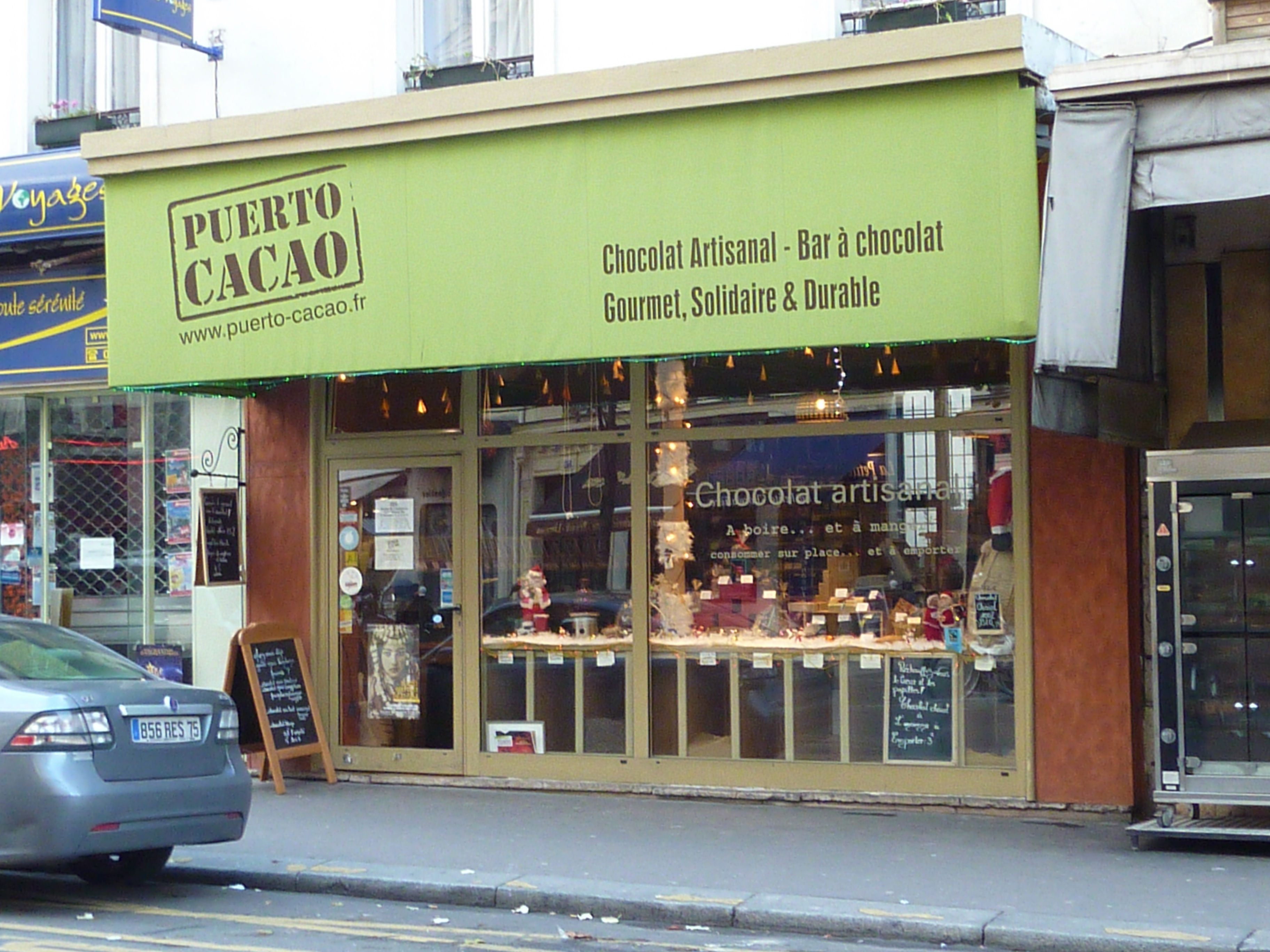
Puerto Cacao
(c) Discover Paris!

On a recent excursion into the 17th arrondissement, we stepped into Puerto Cacao, a chocolate shop that processes cocoa beans to make its own confections. (Most of the chocolate vendors that we have heretofore reviewed either create their own confections from refined chocolate or resell chocolates that have been made by somebody else.) The store is spacious and well stocked with sweets in just about every conceivable form, from dark chocolate, to milk chocolate, to white chocolate. Having been inspired by the hot chocolate of Le Cuillère Suisse (which I reported on in my blog of Wednesday, November 17), we were looking for an alternative way to make the beverage.

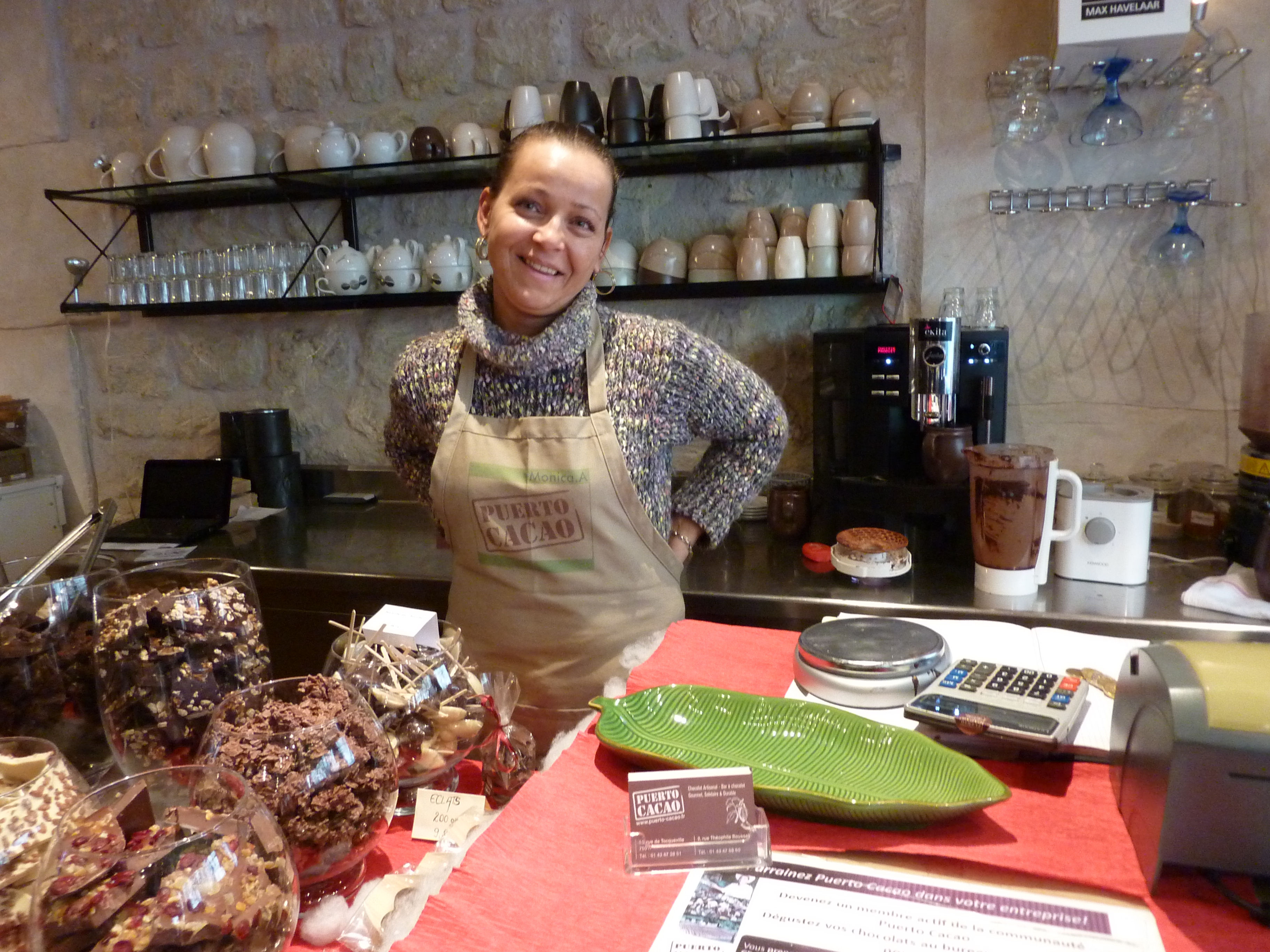
We were greeted by salesperson Monica Ardelean, who explained to us that she had two products that would serve for making hot chocolate. One was a powdered cocoa sold in a bag; the other was a solid block of Venezuelan chocolate. She expressed greater enthusiasm for the second product, saying that it produced a better brew. Indeed, she sold hot chocolate in her shop and invited us to taste it! We found it hearty and somewhat bitter, but not unpleasantly so.

Monica Andelean
(c) Discover Paris!

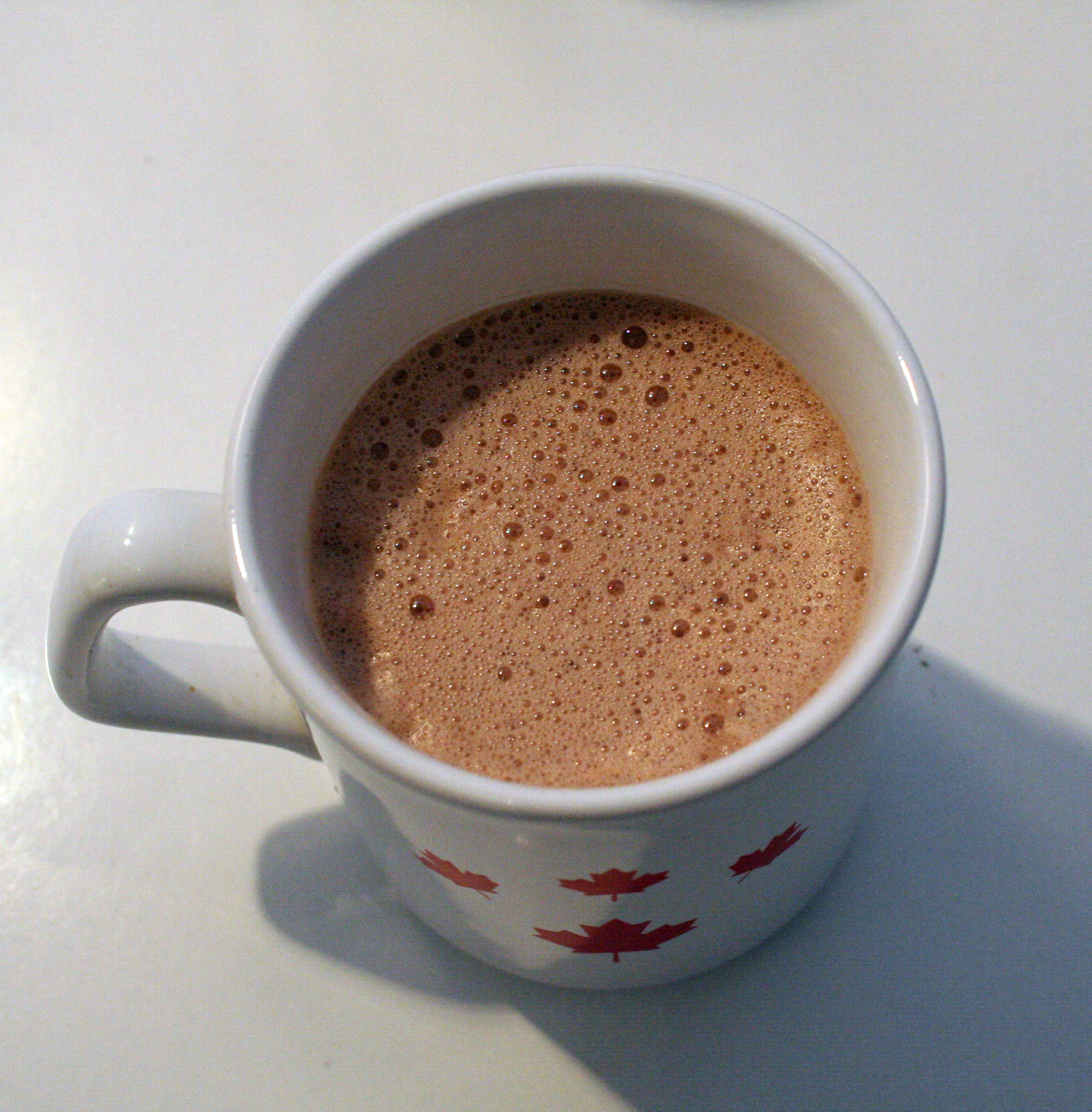
We purchased a 310-gram block of the chocolate for 5€ and took it home to try the recipe that Monica gave us. We cut 100 grams (3.5 oz) off the block and melted it in a double boiler on the stove. At the same time we heated one liter (about one quart) of milk in a saucepan. When the chocolate was melted and the milk was hot, we stirred about one-half cup of hot milk into the chocolate, along with 15 grams (about one tablespoon) of sugar and about one-quarter teaspoon of vanilla. We then blended this mixture in a blender. Monica’s recipe called for transferring the blended mixture into the saucepan of milk and stirring. However, the chocolate paste in the blender was too thick to pour, so we reversed the process, adding the milk from the saucepan into the blender. We turned on the blender and – voilà! – we had a frothy, hot chocolate beverage. (For those who try this, the milk should not be hotter than 80°C (176°F) to avoid damage to the blender.)

We found our hot chocolate to be as bitter as the beverage that we had tasted in the store. We realize that chocolate in its purest form is a bitter product, so we added another tablespoon of sugar and another quarter teaspoon of vanilla. This time, the sugar helped temper the aggressiveness of the chocolate. The beverage was hearty and filling.

Making hot chocolate in this way will try the patience of many, especially those who are accustomed to making chocolate milk from instant cocoa powder. There is the wait while the solid chocolate melts and the milk heats; then there is the task of blending the two liquids together. Finally, there are utensils and countertop to clean up afterwards. But the reward for those with forbearance will be a satisfying cup of hot chocolate made from cocoa beans from Venezuela. It is about as authentic a beverage as you can get!

310-gram Block of Venezuelan Chocolate

Melted Venezuelan Chocolate

Hot Venezuelan Chocolate
(c) Discover Paris!

* * * * * * *

We participate in Wanderfood Wednesdays. Head over there to explore food from around the world!

Like our blog? Join us on Facebook!

Le Timbre

December 3rd, 2010
Facebook Twitter Linkedin

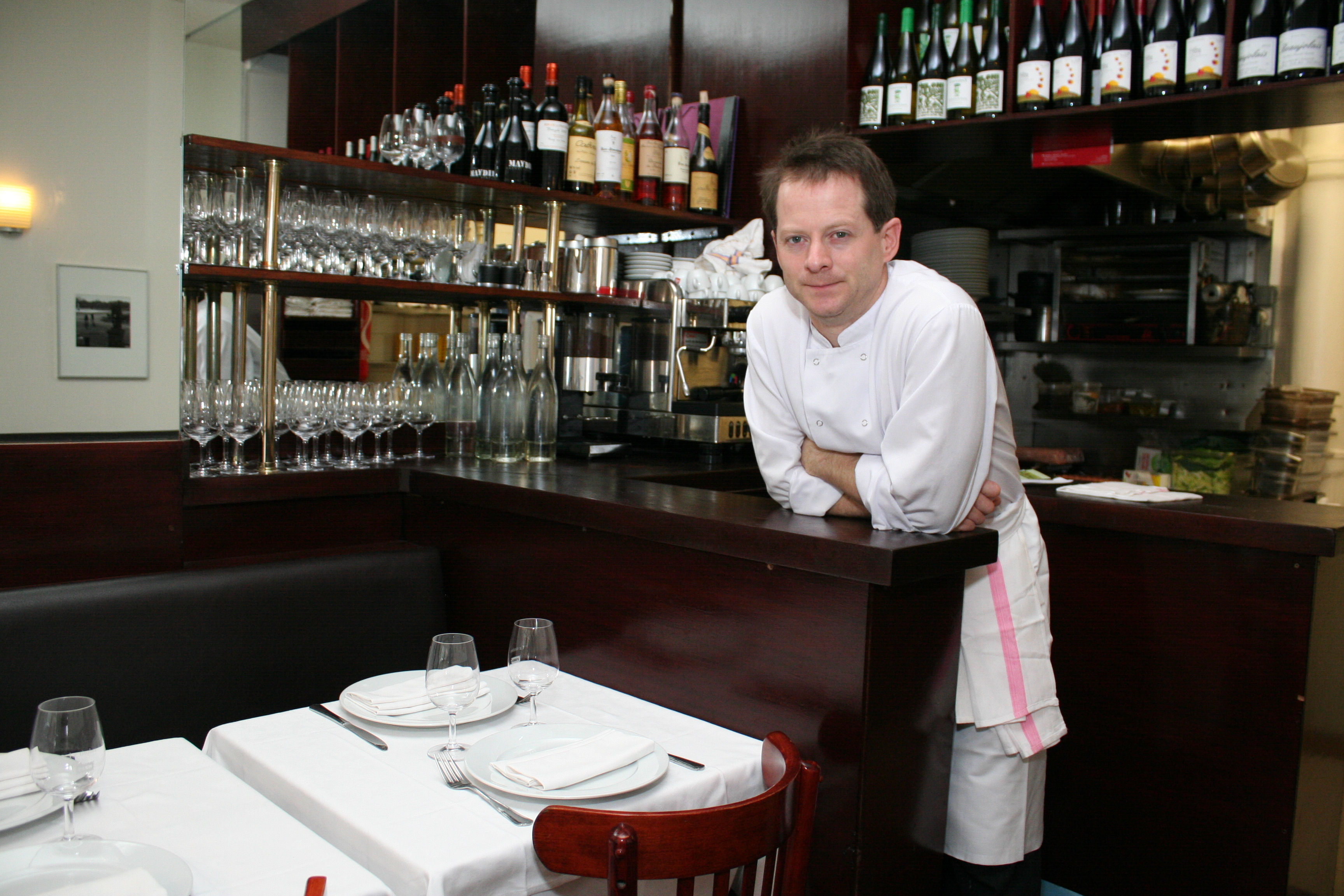
Chef Chris Wright
(c) Discover Paris!

In November, we dined in a tiny establishment called Le Timbre, located in the 6th arrondissement. Owned and operated by Englishman Chris Wright, the restaurant serves French cuisine with his special touches. To learn why we recommend this restaurant as a great place to dine, read our review in this month’s Le Bon Goût.

Le Bon Goût is the restaurant feature that we include in our monthly newsletter Paris Insights. In it, we appraise a Parisian restaurant and give information about its chef.

Access to the newsletter is by paid subscription. Click here to read a brief summary of the December edition, and here to enter a subscription.

Bonne lecture!

* * * * * * *

Like our blog? Join us on Facebook!

A Visit to a Salmon Shop

December 1st, 2010
Facebook Twitter Linkedin

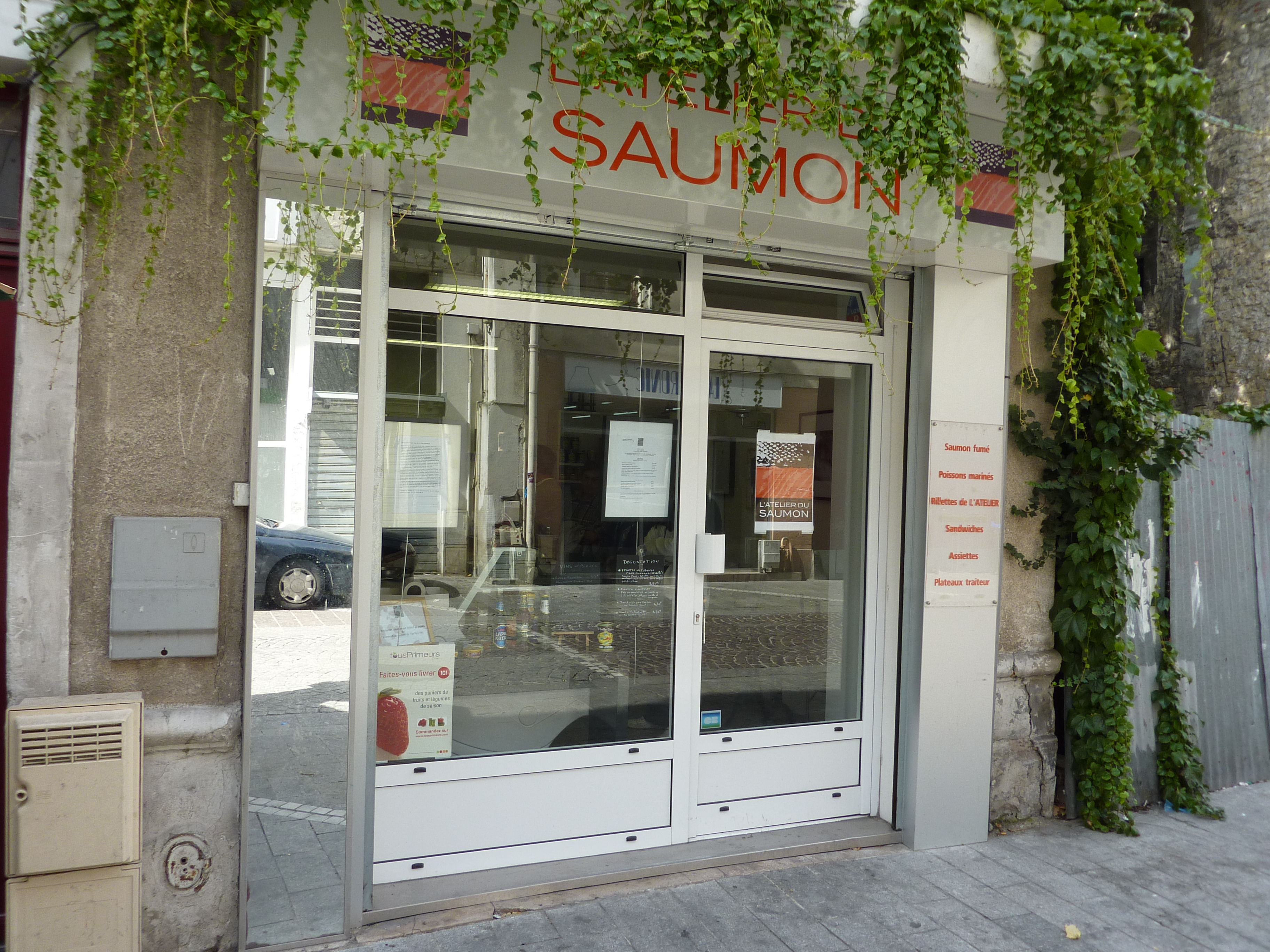
L'Atelier du Saumon
(c)Discover Paris!

The Comité Départemental de Tourisme de Saint-Saint-Denis recently organized a visit to L’Atelier du Saumon, a store in the town of Saint-Denis where fresh Scottish salmon is processed. The owner of the store, Laurent Leymonie, gave a one-hour presentation about how he prepares the fish for sale.

Leymonie buys only Scottish salmon that is certified “Label Rouge,” a guarantee that food products have undergone certain standards of control and production. The salmon is raised on a fish farm in Scotland and shipped to him. Upon reception of the fish, he follows a five-step process to prepare it for his customers:

• First, Leymonie covers the salmon with pure, white salt for about six to seven hours. Salting removes excess water from the fish and prevents bacteria from growing.
• Next, he places the fish in a drying chamber. This process removes water, but does not dry the fish.
• He then lays the salmon in a smoker where the fish reposes in the smoke of burning beech wood for about six to seven hours at 25° C.
• Following the smoking, he lets the salmon rest 24 hours in a refrigerated chamber, allowing the aroma of the smoke to permeate the fish.
• Finally, he packages the fish for sale, using a special machine to evacuate the air and seal the salmon in a vacuum-tight package.

The resulting product is a delicate, flavorsome fish with a mild, smoky flavor. It is delicious!

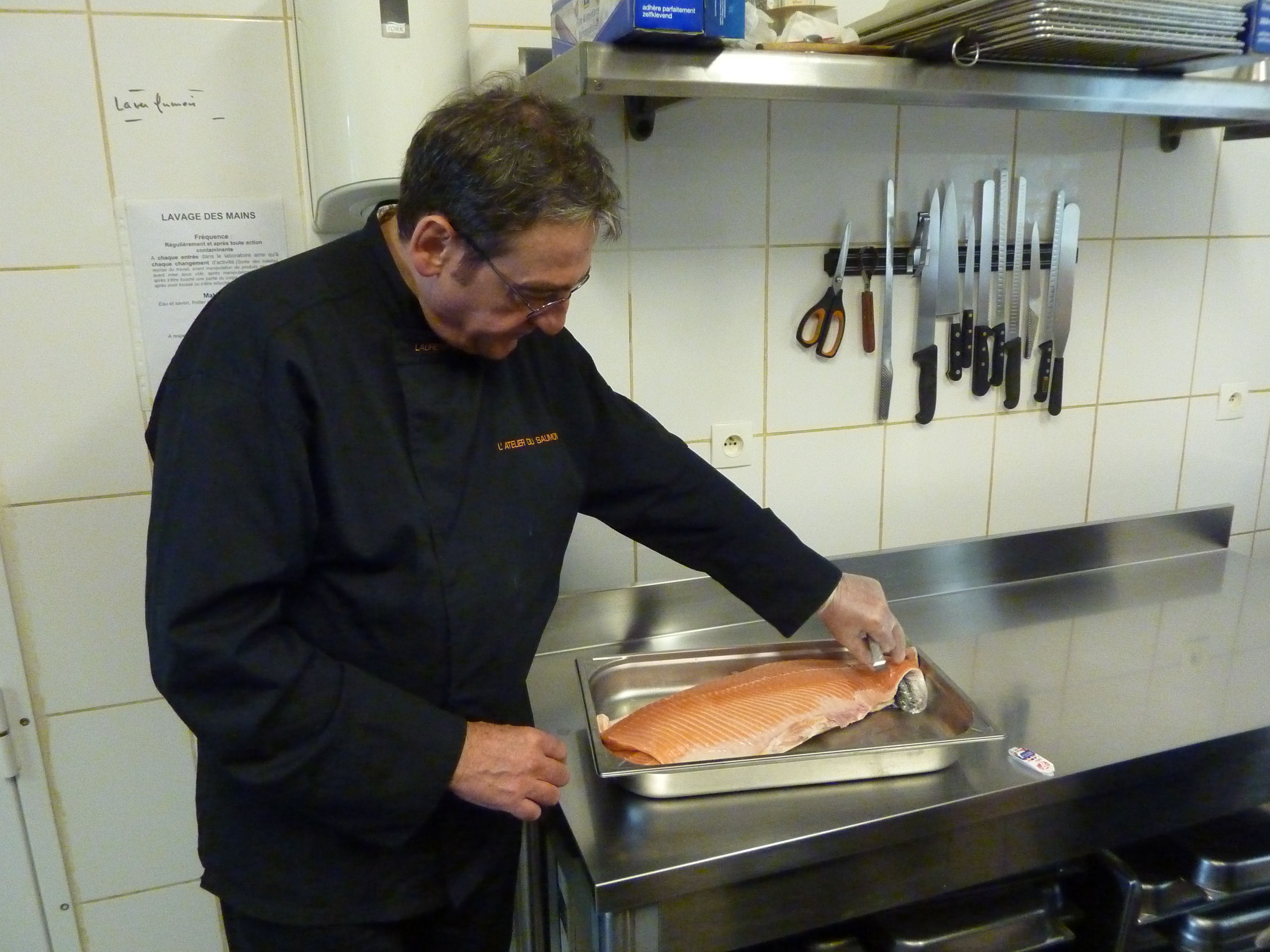
Laurent Leymonie
(c) Discover Paris!

Part of Leymonie’s presentation was a demonstration of the technique for slicing the fish. Participants were encouraged to try their hand at it; best of all, following the slicing was the tasting!

Perhaps even more interesting than learning about the preparation of salmon was to learn that Mr. Leymonie worked for thirty years as a cameraman and photo director. Perceiving changes in the industry and a diminution of his passion for the work, he decided that the moment had come to switch careers. He enrolled in the cooking school École Ferrandi and received a Certificate d’Aptitude Professionnelle. During his studies he was introduced to the techniques of smoking salmon and decided that he would pursue a career in that niche. This was a good choice, given that his lack of experience in the restaurant industry at his age would prohibit him from entering a career path in cuisine. After a period of experimenting with various techniques of smoking salmon, he was ready to open his shop. Today he has loyal customers, including a number of restaurants that purchase his product.

Bon appetit!

L’Atelier du Saumon
11, rue de la Charronnerie
93200 Saint Denis

Telephone: 01.49.22.06.13

Open from Tuesday to Saturday, from 10:30 a.m. to 7:00 p.m.

Web site: www.atelierdusaumon.com

* * * * * * *

We participate in Wanderfood Wednesdays. Head over there to explore food from around the world!

Like our blog? Join us on Facebook!

Sunday Afternoon on Rue Boyer

November 27th, 2010
Facebook Twitter Linkedin

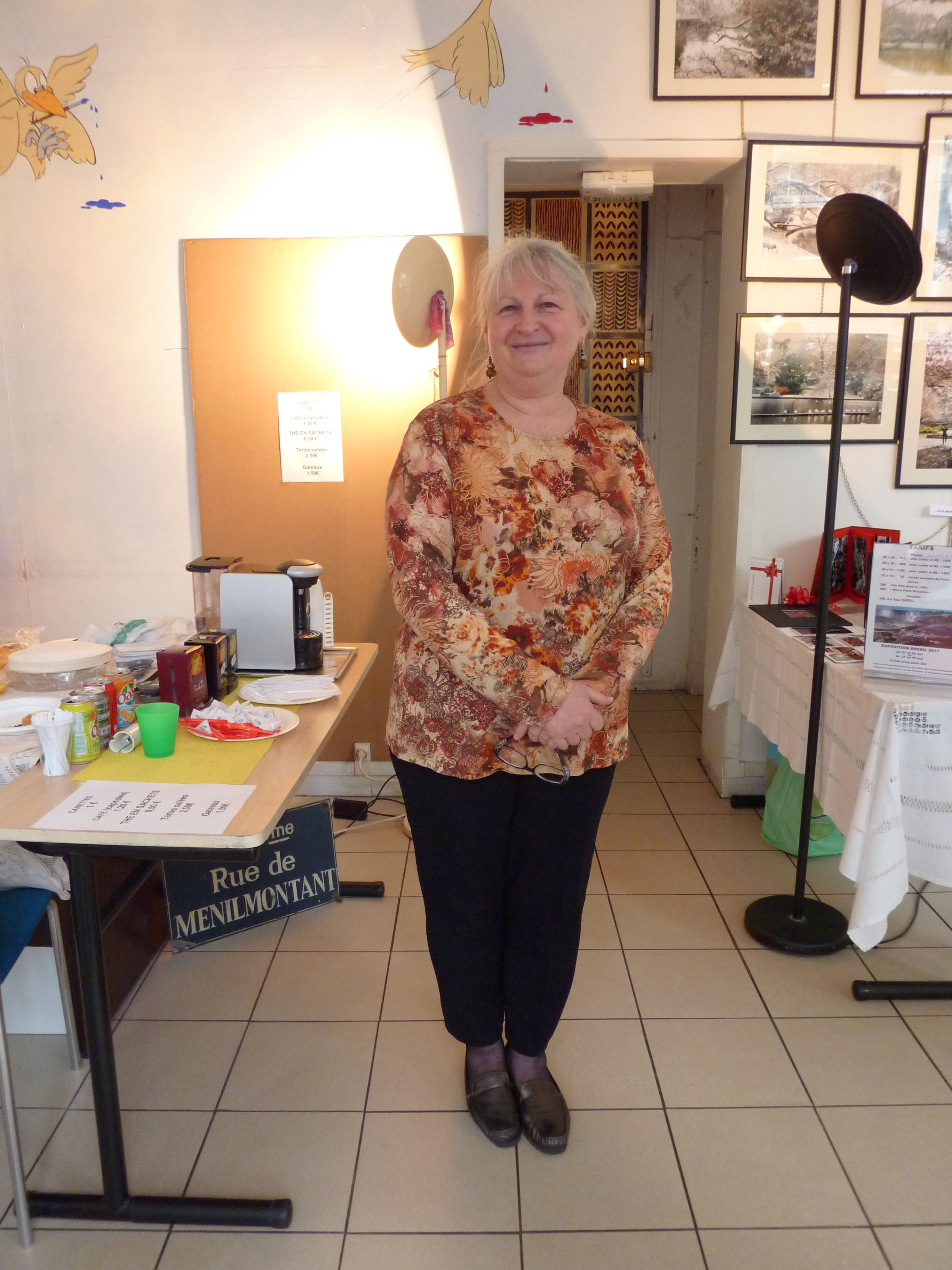
Last Sunday afternoon found me on rue Boyer, in the far-off (from where I live) 20th arrondissement. I happened by a community center called Espace Arts Lebaudy at number 2 and noticed that there was an art and photography exposition going on. I stepped in to take a look, and was glad that I did, because I spoke with some very nice people.

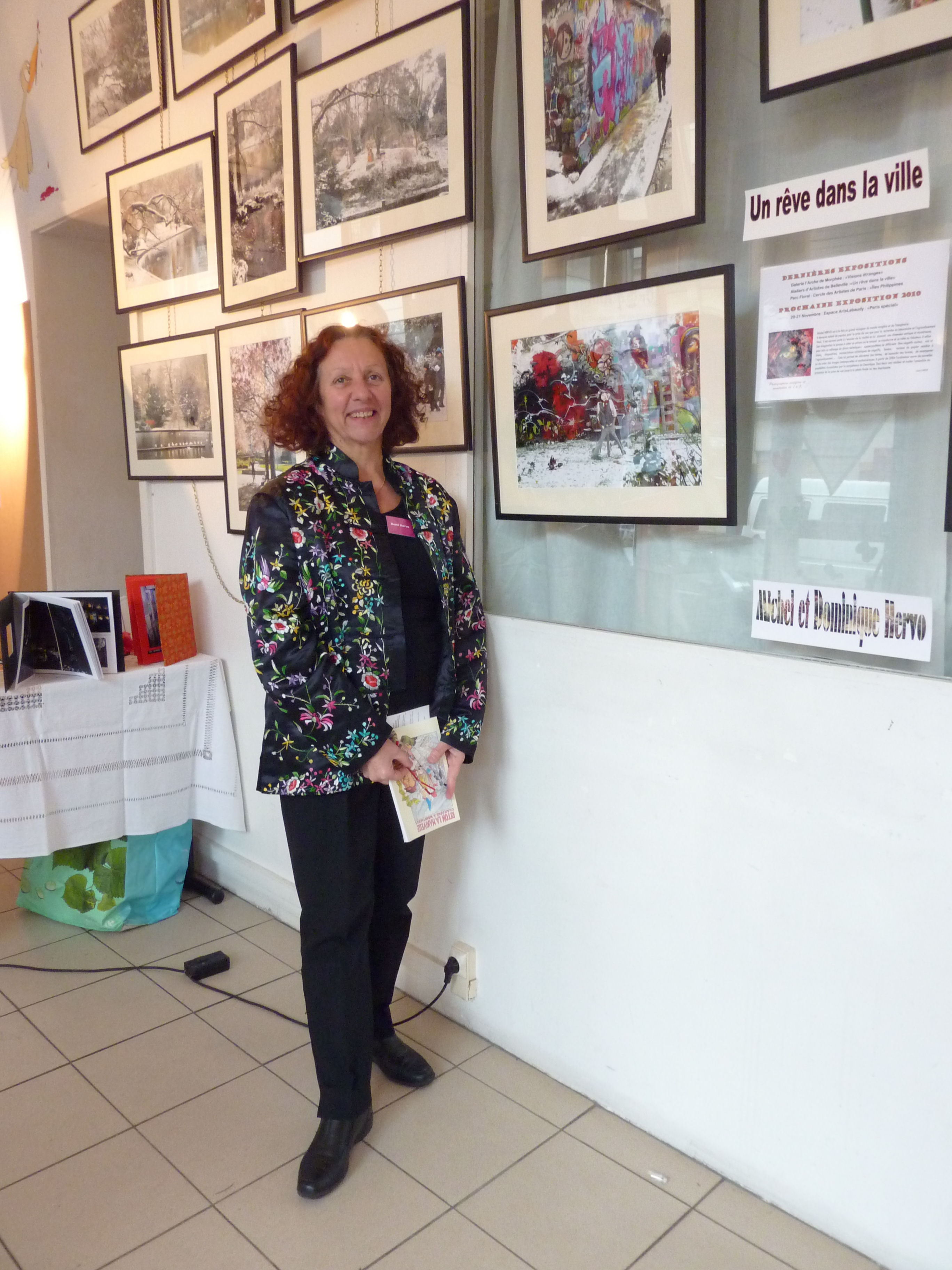
I met Dominique Hervo who was exhibiting color photographs taken by her husband Michel. She told me that the photos that I was looking at were taken last year during the time when Paris had a heavy snowfall. It was Michel’s photo of dappled colors of graffiti on a wall that had caught my eye and brought me in to view the works.

Dominique Hervo
exhibiting photos by Michel Hervo
(c) Discover Paris!

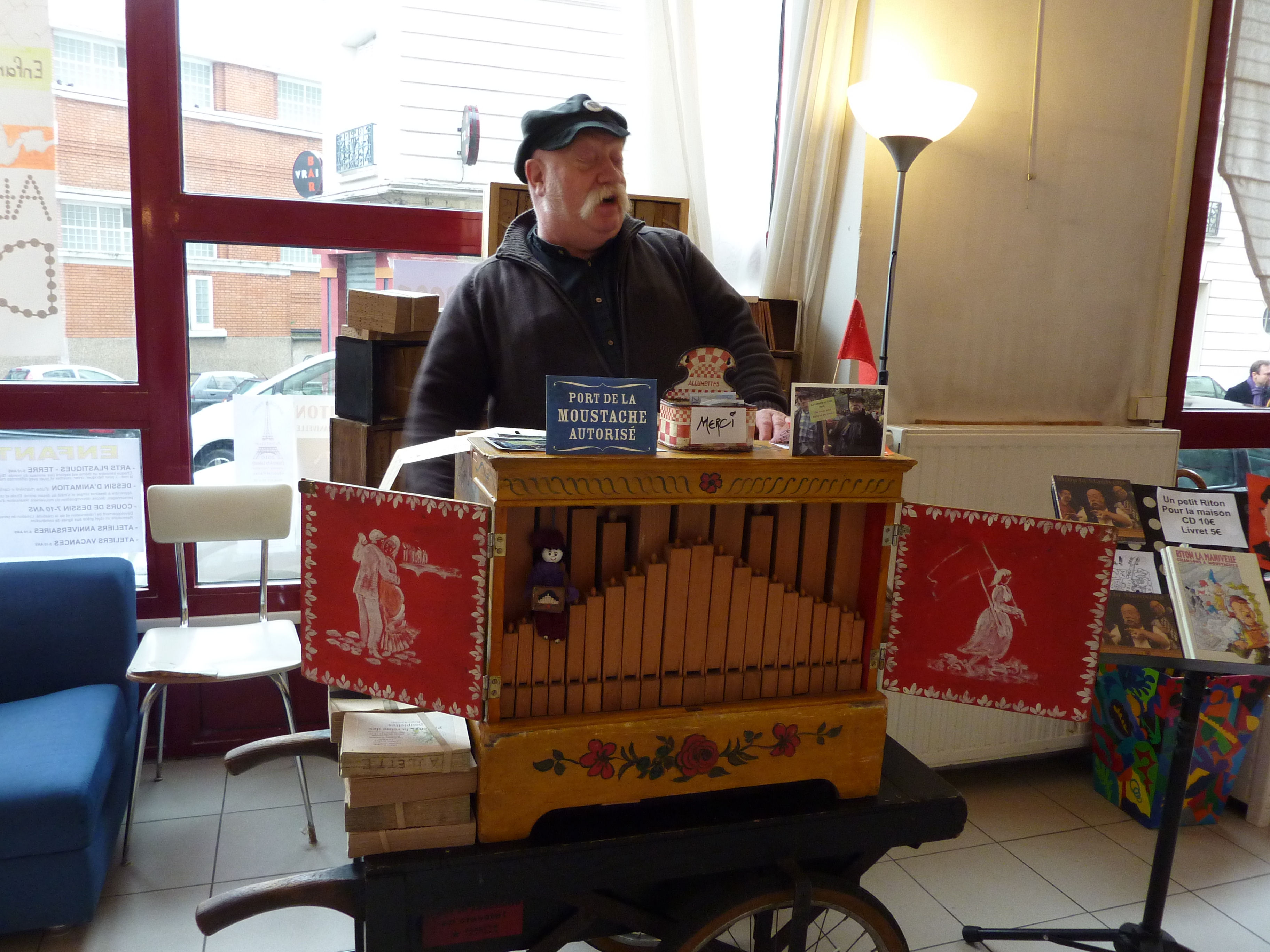
While I was talking with Dominique, the room suddenly jumped to life with the sound of an organ grinder. It was Riton la manivelle, turning the crank of his orgue de Barbarie and singing in a rich, full voice. His music gave a festive atmosphere to the exposition.

Riton la manivelle
(c) Discover Paris!

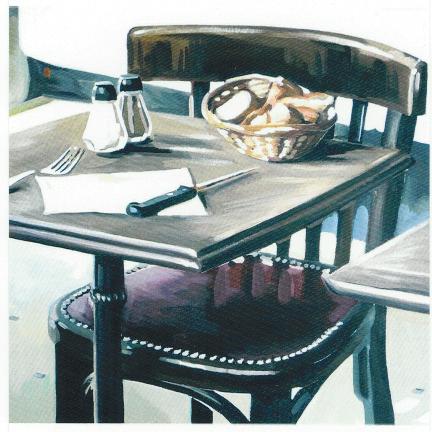
Next to Dominique was the second exhibitor, a painter named Isabelle Faivre. Many of her paintings were of everyday scenes of Paris. I purchased a postcard of one of them, shown below. While browsing her Web site, I learned that she is also a book sculptor.

Gouache sur toile by Isabelle Faivre
Photograph courtesy of Isabelle Faivre

I purchased a cup of hot chocolate from a woman who was serving beverages and sweet and savory pastries. It turned out that she is the founder of this community center, which, for the moment, receives no funds from the city. Her name is Sylvie Dimet, and she launched Espace Arts Lebaudy under her own initiative in April 1997. The espace offers courses in art and design for children and adults. Sylvie teaches plastic arts and animation. Some of the animated videos that her young students (from 7 to 17 years old) have produced can be seen on the Espace Arts Lebaudy Web site. The espace will host a Festival of Animated Short Films 2D/3D in September 2011. Entry is open to all. Details can be found on the Croq’ Animé Web site. All entries must be received by June 30, 2011.

Sylvie Dimet Founder of Espace Arts Lebaudy(c) Discover Paris!

Sylvie Dimet
Founder of Espace Arts Lebaudy
(c) Discover Paris!

Mälarchocolaterie

November 24th, 2010
Facebook Twitter Linkedin

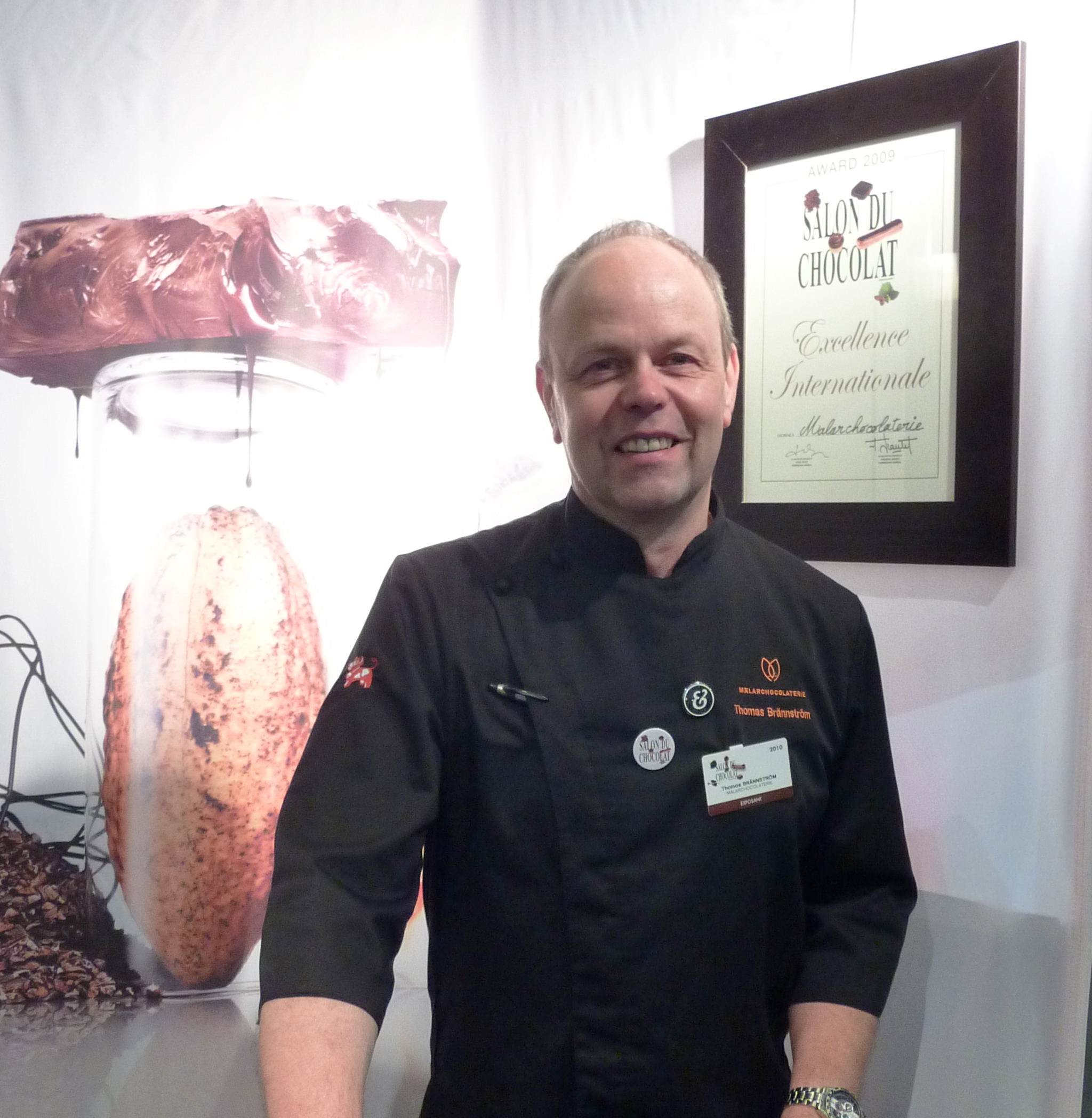
Thomas Brannstrom
International Excellence Award
Salon du Chocolat 2009
(c) Discover Paris!

We met Thomas Brannstrom at his stand Mälarchocolaterie at the Salon du Chocolat. He and his wife, Elaine Chan, produce handmade chocolates at their facility in Vasteras, Sweden. A photo of them together appears on their Web site.

Brannstrom expressed great enthusiasm not only about his line of chocolates, but also about every aspect of the business, from the packaging of his product to the designing and construction of the Mälar exhibition stand at the salon. He proudly pointed out that the beautiful boxes in which the chocolates are sold are created from the fiber of a renewable wood that grows in the forests of Sweden. He was so keen about explaining the minimal environmental impact of his operation that we were hard pressed to turn his attention back to what we were most interested in—chocolate!

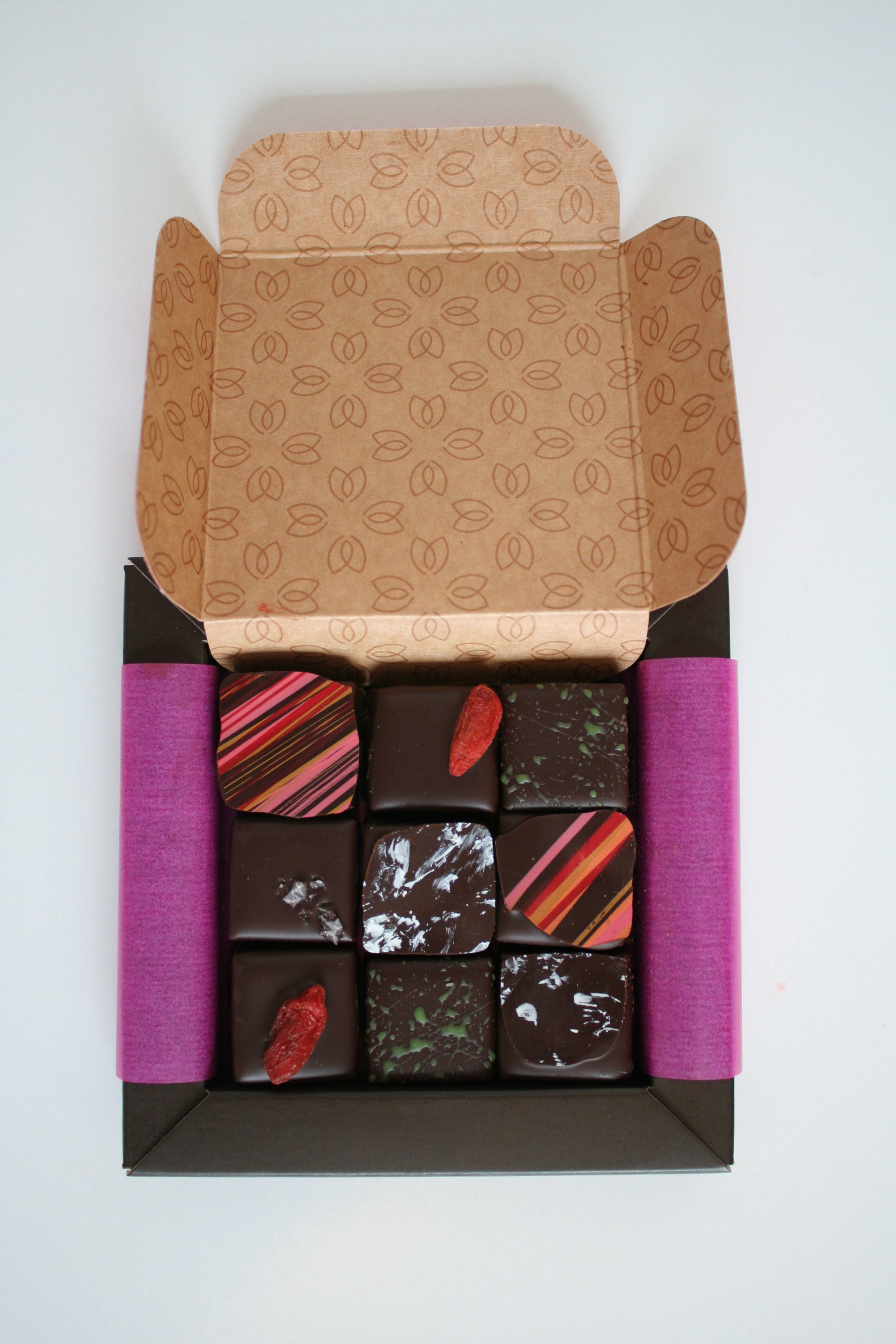
We purchased the smallest box and selected an assortment of nine chocolates to place in it. Each variety is exquisitely designed, and many have unusual flavors. I did not realize until later that Mälar produces a number of exotic flavors, including horseradish. I would like to have tried that!

Here is a list of the chocolates that we did taste:

Wolfberry (goji berry) – The wolfberry is cultivated in China. It is a tiny red fruit, and one can see it on top of two of the chocolates in the photograph (below). I was unable to taste the berry in the chocolate, but my partner could. She said that it was reminiscent of cranberry, but not as intense. We both found the chocolate ganache quite flavorful.

Citron Tequila Salt – Lemon-flavored chocolate ganache with a salted top. We could not taste the tequila, but found the chocolate sublime. A cute idea to match lemon, tequila, and salt with chocolate!

Single Malt Whisky – A mild taste of whisky in rich, dark chocolate with an aftertaste of peat.

Port Melon – We were not sure that we tasted melon in this, but we found the chocolate ganache to be as good as they get!

Apple Calvados (apple brandy) – Intensely smooth, unctuous, refined chocolate. My partner tasted a hint of Calvados in the ganache, but I could not.

In retrospect, we realize that we tasted the chocolates in the wrong order, and that the essence of the more subtly flavored varieties was probably masked by the more assertive flavors of others.

Although we could not always identify the flavors for which these chocolates are named, we agree with Mälarchocolaterie’s claim that its chocolates are a “Swedish chocolate luxury.”

Elaine Chan at the Mälarchocolaterie Stand
(c) Discover Paris!

Mälar Chocolates
(c) Discover Paris!

* * * * * * *

We participate in Wanderfood Wednesdays. Head over there to explore food from around the world!

Like our blog? Join us on Facebook!